According to the law of attraction, inner weaknesses attract adversities. Unfortunately, we struggle tracing adversities back to inner weaknesses. Instead, we like to blame other people or external circumstances for our difficulties.
This is where psychological Tarot readings come in. They do exactly that: they trace the adversity of the querent back to their inner weaknesses. Think of it as karmic forensics.
You probably know forensics from criminology. When the police discover a crime, they call in forensics to find clues linking the crime scene to the perpetrator.
In the context of psychological Tarot readings, the adversity is the crime scene, and the querent’s weakness is the perpetrator. Psychological Tarot readings can connect the adversity to an inner weakness.
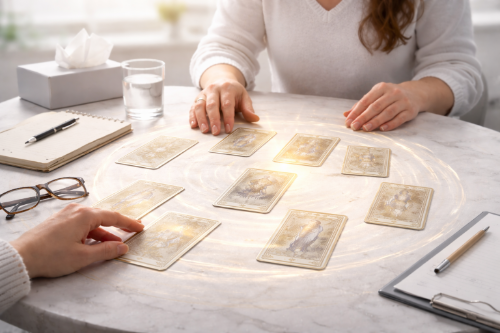
Weaknesses are Immature Faculties of Consciousness
Each Tarot card represents a faculty of consciousness. We can use faculties of consciousness constructively or destructively. This produces either favorable or unfavorable states of mind, which, in turn, attract fulfilling or adverse experiences.
A weakness is a faculty of consciousness that we have not yet mastered.
A faculty of consciousness may be absent or out of control. If the mind lacks vitality, depressive symptoms may appear. If too much energy is present, signs of ADHD may appear.
Once we identify the faculty of consciousness involved in our adversity, we can learn to use it constructively. When we manage to do so, the adversity will disappear from our lives.
Psychological Tarot Readings Can be More Effective than Dream Interpretation
Sometimes the subconscious sends us messages in our sleep that help us deal with adversity. It forms a dream from symbols, archetypes, and allegorical memories.
For the conscious mind, such dreams remain ambiguous and require interpretation.
In a psychological Tarot reading, the querent invites the subconscious to draw one or more cards from the deck to convey its message.
Instead of constructing an ambiguous dream, subconsciousness can select one or more cards that embody its message. This works because Tarot cards contain symbolism and archetypal imagery with which the subconscious can work.
Applications
Psychological Tarot readings can reveal the hidden causes of challenges, such as:
- Relationship and family conflicts
- Parenting challenges
- Psychological challenges
- Health challenges
- Financial challenges
- Loneliness
- Work-related stress
- Unexpected change
Divine Your Business
Do you struggle with recurring conflicts and challenges in your business?
Do you encounter ambiguous resistance?
Are team dynamics out of control?
Does your business get stuck in the same situations?
Do business decisions feel heavy?
Do you notice recurring patterns that seem to have no clear cause?
Has progress slowed down, and you don’t know why?
Book a psychological Tarot reading for your business. Understand the psychology of your business and trace business adversity back to your organization’s inner weaknesses.
If you would like to book a psychological Tarot reading for your business, please use the contact form below to request an offer.
Tarot in Psychological Research
More and more psychologists are studying Tarot and exploring its use in psychoanalysis and therapy.
In her academic paper “Tarot as a Projective Technique”, published in Spirituality and Health International (2006), Inna Semetsky examined Tarot within the framework of clinical-reflective Jungian therapy.
Semetsky argues that Tarot cards can serve as a projective medium, similar to Rorschach inkblots* or the Thematic Apperception Test (TAT)**.
Projection means that people transfer their own thoughts, feelings, or conflicts onto a person or object. A projective medium must therefore be ambiguous, symbolically rich, and open to interpretation, which Tarot cards provide.
Semetsky’s key findings:
- The interpretive process using Tarot resembles depth psychology and Jungian symbolic analysis.
- Tarot cards can mediate between conscious reflection and unconscious structures.
- Tarot cards can promote psychological insight through metaphor and symbolism.
- Tarot images can stimulate narrative externalizations of inner states.
In 2009, G. M. Hofer wrote the honors thesis Tarot Cards: An Investigation of Their Benefit as a Tool for Self-Reflection at the University of Victoria. In this qualitative exploratory study, Hofer examined how participants describe their psychological experiences when working with Tarot, particularly regarding insight, personal reflection, and meaning-making.
Hofer’s findings:
- Participants reported that Tarot can act as a strong reflective stimulus.
- Tarot cards catalyze the narrative expression of complexes.
- Tarot cards help clarify emotions.
- The symbolic ambiguity of the images enables the projection of personal meaning.
In “The Mirror, Not the Crystal Ball: A Psychological Analysis of Tarot as a Self-Reflection Tool”, Yiu Kwong Au-Yeung describes Tarot as a symbolic instrument of reflection. He used Tarot within narrative psychology, sense-making methods, and interpretive psychology.
Au-Yeung’s findings:
- Tarot cards can function as ambiguous symbolic stimuli.
- Interpretation involves narrative expression.
- The reflective process resembles guided self-inquiry.
- Symbolic distance can facilitate emotional articulation.
- The cards can elicit interpretive dialogue.
In Divining the Self: Applying Tarot as a Projective Technique in Counseling, a graduate thesis from James Madison University, Eileen Clinton examines Tarot as a potential projective technique in counseling. Building on theories of projective methods such as Rorschach and TAT, she argues that Tarot images can serve as symbolic stimuli that invite clients to talk about their inner experiences.
Clinton’s findings:
- Symbolic imagery helps clients articulate unconscious or emotionally complex material.
- Tarot cards can mediate between counselor and client and reduce defensiveness.
- Meaning emerges through the client’s interpretation rather than fixed card meanings.
Clinical psychologist Arthur Rosengarten published the book Tarot and Psychology: Spectrums of Possibility (2000). In his case study “Symbolism and Tarot in Jungian Psychotherapy”, Tarot cards were used in analytical psychotherapy, Gestalt work, dream interpretation, and shadow work. The study showed that Tarot cards can help clients recognize and articulate unconscious patterns.
Across these works, Tarot is understood as:
- A symbolic-projective medium
- A tool for self-knowledge
- A catalyst for meaning-making
- A method supporting dialogical exploration
Overall, a consensus is emerging that Tarot can function as a catalyst for:
- Projection
- Self-narrative
- Reflection
- Positive suggestion
- Meaning-making
* The Rorschach method (“inkblot test”) uses images to reveal unconscious psychological patterns such as fears. Because inkblots are random, the results can be random as well—similar to fishing. Tarot cards can stimulate the subconscious more deeply because their archetypal imagery speaks directly to it and stimulates associative functions. Practitioners can also deliberately select cards such as Reason, Truth, or Sacrifice to address suspected inner complexes.

** The TAT (Thematic Apperception Test) is a projective psychological method in which a therapist shows pictures to a client who then tells stories about them.
Important Notice Regarding the Terms and Conditions
The services offered are based on models of positive psychology, symbolic work, and self-reflection. The activity takes place exclusively within the framework of coaching, consciousness work, and personal development. No diagnoses are made, no healing treatments are performed, and no promises of healing are given. The offers do not replace medical, psychotherapeutic, or alternative medical treatment.
If you have health concerns, please consult a licensed physician, psychotherapist, or alternative practitioner. Participation is voluntary and undertaken at one’s own responsibility. A normal level of psychological and physical resilience is required.
The term “psychological” refers only to a methodological orientation toward psychological models and does not constitute authorization to practice psychotherapy under the Psychotherapists Act.